

A Profitable Strategy for Short-Term Traders
How to use VIX Index for Mean-Reverting SPY Opportunites

Markets rarely fall in calm, orderly ways; as the old Wall Street adage goes, they “take the stairs up and the elevator down.”
We also know that during downside moves, technical and behavioral forces can trigger positive feedback loops that exacerbate market sell-offs.
Investors cut risk, volatility-managed strategies deleverage, hedgers chase protection, and the price of downside insurance rises faster than fundamentals alone would seem to justify. In other words, downside moves are often made worse by the way investors react to them.
At the same time, speculators who have kept capital available for richer opportunities can step in, provide liquidity to forced sellers, and try to exploit abnormal corrections.
As quantitative traders, we often look to implied volatility to identify short-term panic regimes. The VIX, commonly referred to as the “fear gauge”, is the best-known measure of this kind: in technical terms, it reflects the level of implied volatility embedded in S&P 500 option prices, providing a market-based estimate of expected volatility over the next month.
In several of our previous studies, we have shown how investors tend to overpay for such protection. This creates profitable trading opportunities in VIX-linked instruments and derivatives…
One example is documented in our paper “The Volatility Edge”, which recently placed fifth in the 2026 Quantpedia Awards.

… but we think there is another way to exploit the VIX.
For instance, we can use it to identify when equity markets enter a temporary stress regime, when moves tend to become over-amplified by the technical and behavioral forces described above, and then implement the trade directly through SPY.
In this article, we present a simple system built around three core components:
A VIX-based signal to identify volatility bursts;
Position-sizing rules to exploit prolonged weakness;
Exit criteria designed to capture a potential market rebound.
From January 2007 through June 2026, our framework generated a 10.8% CAGR net of fees, while being active on only 14% of trading days.
The strategy does not require continuous intraday monitoring or discretionary intervention: signals are computed shortly before the close and implemented via market-on-close (MOC) orders, resulting in a relatively simple operational workflow.
In this article, we walk through how the signal is defined, how exposure is increased when stress persists, how the same-day implementation avoids look-ahead bias, and where the approach’s strengths and weaknesses appear in the data.
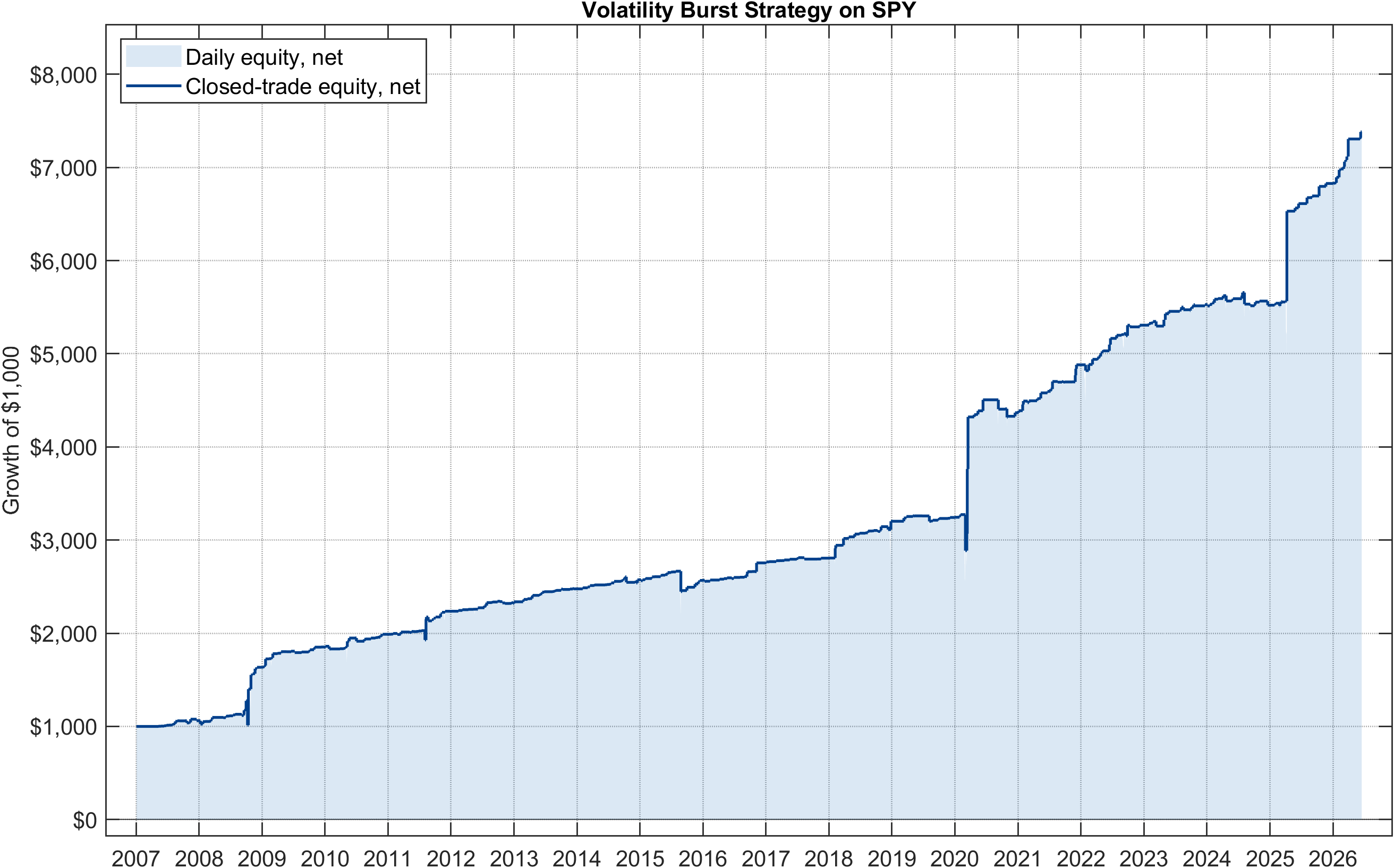
We also view this as the first step in a broader research project. The results are promising enough that, over the next few weeks, we plan to publish a follow-up piece applying the same methodology across multiple assets and implied-volatility indexes, along with Python code to help readers automate the strategy via Interactive Brokers APIs.
Note for the reader. This article presents the findings of an empirical research study based on historical market data. The results are derived from backtests and therefore reflect past market behavior, which may differ materially from future market conditions. While historical analysis can provide useful insights into systematic trading strategies, it should not be interpreted as a guarantee of future performance or as investment advice. Readers are encouraged to evaluate the methodology critically and draw their own conclusions regarding its potential applicability.